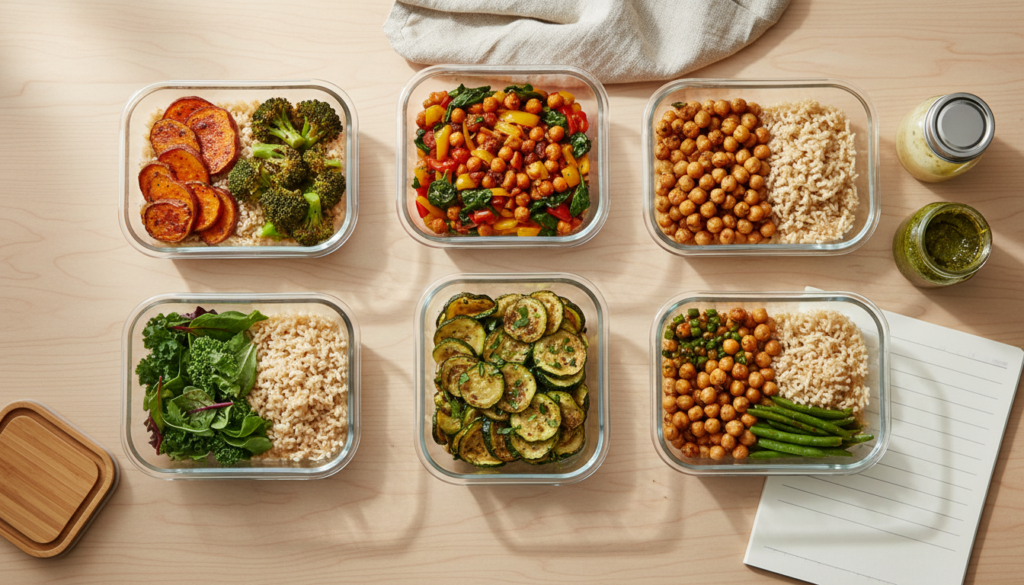
The best meal prep tips for weight loss make your week easier without turning food into a rigid set of rules. Start with a few repeatable meals, include satisfying protein foods, vegetables and grains, and pack portions that work for your appetite and routine. Meal planning can help you cook at home more often, but no recipe box, portion size or single food guarantees weight loss.
This guide goes beyond generic advice. You’ll get a complete five-lunch example for one adult, a grocery list with measured ingredients, step-by-step Sunday prep, a safe refrigerator/freezer schedule, and ways to adapt everything. It is an editorially developed example, not a kitchen-tested or medically prescribed meal plan.
The Five-Lunch Meal Prep Plan at a Glance
| What you prep | How many lunches | What goes in it |
|---|---|---|
| Lemon chickpea and brown rice bowls | 3 | Cooked chickpeas, brown rice, roasted zucchini, red pepper and onion; lemon to finish |
| Paprika chicken and quinoa bowls | 2 | Fully cooked chicken breast, quinoa, roasted broccoli and carrots |
| Sunday storage | 3 chilled + 2 frozen | Monday, Tuesday and Wednesday portions in the fridge; Thursday and Friday portions in the freezer |
The two-bowl format gives you some variety without asking you to cook five separate recipes. These are lunch examples, not a complete daily diet. Breakfast, dinner and snacks can be chosen around personal needs. The CDC’s meal-planning guidance encourages preparing food at home and including a range of protein foods, vegetables and whole grains.
Grocery List for Five Meal Prep Lunches
This list makes three chickpea bowls and two chicken bowls for one adult. Quantities are ingredient measurements, not calorie prescriptions. Check your pantry before shopping; frozen vegetables are a practical alternative if fresh produce is expensive or unavailable.
| Shop for | Amount for all five lunches | Used for |
|---|---|---|
| Canned chickpeas | Two 15-oz (425 g) cans; drain and rinse | Three chickpea bowls |
| Boneless skinless chicken breast | 12 oz (340 g), raw | Two chicken bowls |
| Dry brown rice | ¾ cup (about 140 g); cook according to package | Three chickpea bowls |
| Dry quinoa | ½ cup (about 85 g); cook according to package | Two chicken bowls |
| Zucchini, bell pepper, red onion | 2 medium zucchini, 1 red bell pepper, 1 small red onion | Roasted vegetables for chickpea bowls |
| Broccoli and carrots | 3 cups broccoli florets and 2 medium carrots | Roasted vegetables for chicken bowls |
| Lemons and garlic | 2 lemons and 2 garlic cloves | Flavoring and serving |
| Olive oil and seasoning | 3 tablespoons olive oil; 1 teaspoon smoked paprika; salt and pepper to taste | One tablespoon oil for each vegetable tray and one for chicken |
| Optional garnish | Small handful of parsley or chopped herbs | Add after reheating |
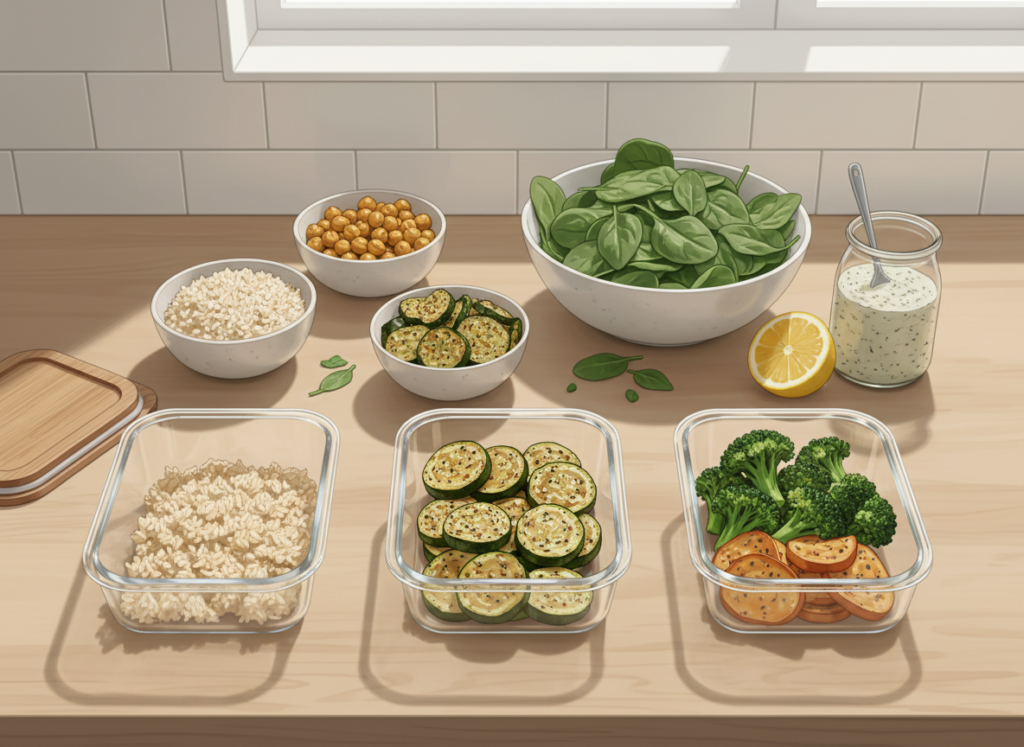
How to Prep Five Lunches in One Cooking Session
Allow roughly 60–90 minutes including chopping, cooking grains, roasting vegetables, cooking chicken and packing. This is an estimate, not a timed kitchen test; brown-rice brands and chicken thickness can change the schedule. You’ll need two pots, two baking sheets, a skillet, a food thermometer and five food-safe containers. Clean utensils and a cutting board reserved for raw chicken help avoid cross-contamination.
Step 1: Start the grains and heat the oven
Preheat the oven to 425°F (220°C). Cook the ¾ cup dry brown rice and ½ cup dry quinoa in separate pots, using the water ratios and cooking times on their packages. Fluff them when done. The cooked quantities will vary by brand; divide each batch evenly into its designated bowls rather than promising an exact yield.
Step 2: Roast the chickpeas and vegetables
Drain and rinse both cans of chickpeas. Dice the two zucchini, red bell pepper and small red onion. Toss the chickpeas and vegetables with 1 tablespoon olive oil and a little pepper; spread on a clean baking sheet. Roast for approximately 20–25 minutes, turning once, until the vegetables soften and begin to brown. These are already-cooked canned chickpeas, so the goal is texture and flavor, not cooking raw dried beans.
Step 3: Roast the broccoli and carrots
On a second sheet, combine the 3 cups broccoli and sliced 2 carrots with 1 tablespoon olive oil. Roast for roughly 18–25 minutes, depending on the size of the pieces, until tender and lightly browned. Keep these vegetables separate from utensils that have touched raw chicken.
Step 4: Cook the chicken safely
Cut the 12 oz raw chicken breast into two similar-size pieces or flatten thick sections to even thickness. Season with the remaining 1 tablespoon olive oil, 1 teaspoon smoked paprika, minced garlic and pepper. Cook in a skillet over medium heat, turning as needed. Use a food thermometer: the thickest part must reach 165°F (74°C). Do not rely on color or a fixed number of minutes. The FDA’s safe-food-handling chart gives this poultry temperature.
Step 5: Portion, label and chill promptly
Divide the cooked brown rice, chickpeas and zucchini mixture evenly among three containers. Divide the quinoa, fully cooked chicken and broccoli-carrot mixture among two more containers. Add a lemon wedge or squeeze fresh lemon on just before eating. Let hot food stop steaming aggressively only as needed to handle containers, then refrigerate or freeze it promptly in shallow, uncovered or loosely covered containers while cooling; cover securely once chilled. Do not leave food on the counter waiting to reach room temperature.
The Monday-to-Friday Lunch Schedule
| Day | Lunch | What to do on prep day |
|---|---|---|
| Monday | Chickpea, brown rice and roasted vegetable bowl | Refrigerate; finish with lemon after heating |
| Tuesday | Chicken, quinoa, broccoli and carrot bowl | Refrigerate; reheat chicken and grain thoroughly |
| Wednesday | Chickpea, brown rice and roasted vegetable bowl | Refrigerate; check the preparation date |
| Thursday | Chicken, quinoa, broccoli and carrot bowl | Freeze promptly on Sunday; move to the fridge Wednesday evening to thaw |
| Friday | Chickpea, brown rice and roasted vegetable bowl | Freeze promptly on Sunday; move to the fridge Thursday evening to thaw |
If you prep on a different day, shift the labels accordingly. Keep lemon wedges, parsley and other fresh toppings separate; add them after reheating. Your exact portion can be larger or smaller depending on hunger and needs. Food-safety timing is not optional: frozen later-week portions are preferable to leaving cooked bowls in the fridge all week.
10 Best Meal Prep Tips for Weight Loss That Actually Help
1. Prep just one meal category first
Five ready-to-go lunches may be more useful than trying to cook 21 meals at once. Decide whether lunches, dinners or breakfasts cause the most last-minute stress, then focus on that meal. A realistic routine you can repeat matters more than an elaborate Sunday setup.
2. Build around a protein food, produce and a satisfying base
Use beans, tofu, eggs, poultry or another protein food you enjoy, with vegetables and a grain or starch. The CDC recommends a variety of nutrient-dense foods. This is a flexible combination, not a rule that every plate must look identical.
3. Measure cooking oil and sauces instead of guessing
Olive oil, dressing and sauces can add a lot of flavor, but their amounts are easy to underestimate when poured straight from a bottle. Measure the amount you want to use, taste, and adjust. This is more practical than removing all fat or serving bland food.
4. Make two different flavor combinations
Use lemon and herbs for chickpea bowls and smoky paprika for chicken bowls. You can vary seasoning without cooking an entirely different menu. When switching ingredients, remember that allergens, cooking times and storage needs can change.
5. Keep watery and crunchy ingredients separate
Pack sliced cucumbers, leafy greens, crunchy toppings or yogurt-based dressings in separate containers if you want to add them. They may become limp or watery when mixed with hot grains several days ahead.
6. Use portions as a starting point, not a prescription
The quantities above describe how to divide these ingredients across five lunches. They do not define an appropriate calorie intake for you. Hunger, energy needs, activity and health conditions vary. The NIDDK advises choosing a sustainable, personalized approach rather than one-size-fits-all promises.
7. Freeze later-week meals on prep day
If you cook on Sunday, freezing Thursday and Friday lunches promptly protects them from sitting refrigerated too long. Choose ingredients that hold up after thawing: cooked grains, chickpeas, chicken and roasted vegetables generally handle the process better than dressed lettuce. Thaw frozen portions in the refrigerator, not on a countertop.
8. Use affordable shortcuts without sacrificing safety
Canned beans, frozen vegetables and prewashed produce can reduce chopping time. Choose no-salt-added or lower-sodium options where practical, drain canned beans and follow package directions. Pre-cooked foods still need safe refrigeration.
9. Make one grocery list from the actual plan
Check the pantry first, then buy the amounts needed for the meals you will actually eat. If you already have frozen broccoli or rice, use it. This helps avoid the classic problem of purchasing ingredients for five recipes and preparing none.
10. Adjust the routine, not your sense of success
If you skip a planned lunch, safely store or freeze the food and continue normally. Restrictive rules and “fat-burning food” claims are not a substitute for a realistic eating plan. The point is to make regular meals convenient, not to prove that every container was finished.
What About Breakfast, Dinner and Snacks?
These five bowls cover only weekday lunches. For breakfast, consider a food combination you already enjoy, such as plain yogurt with fruit and oats, eggs with toast and vegetables, or chia pudding if it suits your dietary needs. For dinner, vary the foods rather than repeating lunch automatically: a vegetable-rich soup, a grain-and-bean dish, or a cooked protein with vegetables can all be options.
If you are hungry between meals, choose a satisfying snack such as fruit with yogurt, cut vegetables and hummus, or a small portion of nuts. There is no universal number of snacks or rigid timing requirement. See our Mediterranean-inspired lunch ideas for more variety.
How Long Is Meal Prep Safe in the Fridge or Freezer?
For cooked leftovers, a helpful baseline is three to four days refrigerated at 40°F (4°C) or below; freeze anything you will not use in that time. Refrigerate perishable food within two hours of cooking, or within one hour when the temperature is over 90°F (32°C). Use shallow containers to cool batches faster, and keep your freezer at or below 0°F (-18°C). These limits come from FoodSafety.gov’s four food-safety steps and its cold-storage chart.
| Food-safety step | Practical rule |
|---|---|
| After cooking | Divide large batches into shallow containers and refrigerate or freeze promptly; no prolonged counter cooling |
| Refrigerator | Keep at 40°F (4°C) or colder; use cooked leftovers within 3–4 days |
| Freezer | Freeze later-week portions promptly at 0°F (-18°C) or colder; freezing protects safety but quality changes over time |
| Thawing | Move frozen lunch to the fridge ahead of time; do not thaw perishable meals on the counter |
| Reheating | Reheat leftovers to 165°F (74°C), measured with a food thermometer; stir microwaved food to avoid cold spots |
Foodborne germs are not always detectable by smell or appearance. Reheat only what you intend to eat and use a food thermometer when possible. The FDA’s temperature chart lists 165°F (74°C) for poultry and leftovers.
Easy Swaps for Different Tastes and Budgets
| Instead of… | Try… | What changes |
|---|---|---|
| Chicken | Well-cooked firm tofu, lentils or additional cooked beans | Different protein and allergen profile; follow the food’s own cooking guidance |
| Quinoa | Brown rice or another whole grain | Different texture and cooking time |
| Fresh broccoli | Frozen broccoli florets | Often cheaper; roast from frozen if the package allows, allowing more time |
| Fresh bell pepper and zucchini | Seasonal or frozen vegetables | Water content and roasting time may change |
| Smoked paprika | Cumin, oregano or lemon pepper | Different flavor; check packaged seasonings for added salt |
This is not a medically tailored weight-loss program. Anyone with diabetes, kidney disease, food allergies, pregnancy-related nutrition concerns, an eating-disorder history or another condition affecting dietary needs should use individualized advice before following a restrictive plan. No exact calories, macronutrients or weight-loss outcomes are claimed because the ingredients, brands and servings vary and this plan was not nutritionally analyzed.
Frequently Asked Questions
What is the best way to meal prep for weight loss?
Start with meals you enjoy, prep a few protein foods, vegetables and whole grains, and adjust portions to your needs. Planning can support an eating routine, but it does not guarantee weight loss or replace a personalized plan.
Can I meal prep all five lunches on Sunday?
Yes, but refrigerate the lunches for the first three days and promptly freeze the portions for Thursday and Friday. Move a frozen portion to the refrigerator to thaw before you need it, then reheat thoroughly.
How many calories should my meal prep have?
There is no single calorie target that fits everyone. Needs differ by age, size, activity and health conditions. This five-lunch example deliberately does not assign calories or promise weight-loss results.
Can I eat rice or quinoa while trying to lose weight?
Yes. Whole grains can be part of an eating pattern that supports your goals. Portion size, other foods, preferences and overall dietary needs matter more than banning one ingredient.
What if I do not eat chicken?
Use a vegetarian protein you already know how to cook safely, such as firm tofu, lentils or extra cooked beans. Portions, allergens and nutrition will differ; treat this as a variation, not a nutritionally identical swap.
How long do cooked meal-prep bowls last in the fridge?
USDA food-safety guidance recommends using refrigerated leftovers within three to four days at 40°F (4°C) or below. Freeze later portions promptly and reheat leftovers to 165°F (74°C).
Sources and Editorial Transparency
- CDC: Healthy Eating for a Healthy Weight — variety and nutrient-dense eating patterns.
- CDC: How to Have Healthier Meals and Snacks — meal planning and at-home food choices.
- NIDDK: Choosing a Safe and Successful Weight-Loss Program — individualized sustainable plans and unrealistic promises.
- FoodSafety.gov: Four Steps to Food Safety — refrigeration and safe food handling.
- FDA: Safe Food Handling — thermometer temperatures for poultry and leftovers.
Editorial disclosure: The five-lunch quantities and preparation method are a researched, illustrative starting point—not a diet prescription or a kitchen-tested recipe. The accompanying food images are AI-generated illustrations, not photos of meals prepared by this publisher. Nutrition, yield and cooking times have not been independently tested or calculated; adjust to your actual ingredients and follow the food-safety instructions above.